
Al-Qaeda After State Collapse: Historical Lessons and the Iranian Case
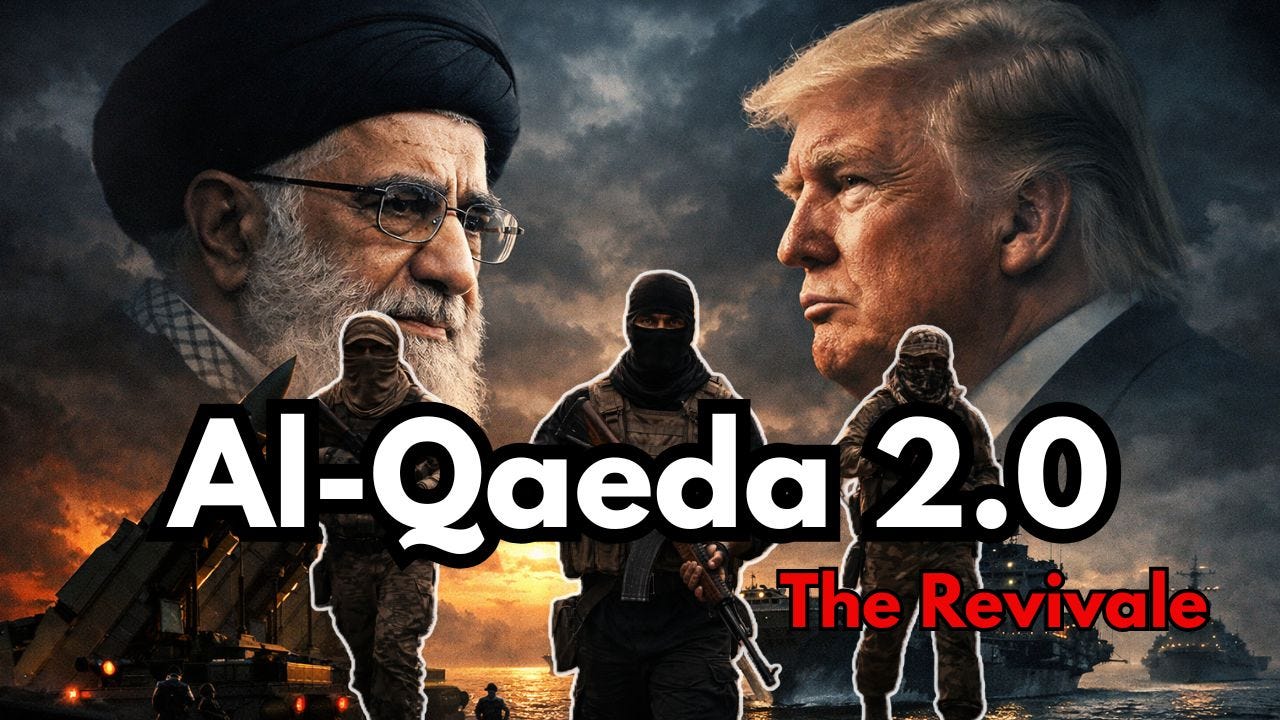
How a War with Iran Could Create Al-Qaeda 2.0

This essay is based on my video analysis: [Watch the video summary on YouTube →]
“There, undeniably, would be no ISIS if we hadn’t invaded Iraq.” — David Kilcullen, former senior adviser to Gen. David Petraeus and Secretary of State Condoleezza Rice
In the blood-soaked archives of America’s 21st-century wars, one lesson screams from every battlefield but remains dangerously ignored: destroying states doesn’t destroy terrorism—it supercharges it.
The 2003 invasion of Iraq didn’t eliminate terror. It birthed ISIS—a monster more savage and territorially ambitious than anything Saddam Hussein ever harbored. Now, as geopolitical tensions with Iran escalate, a dangerous fantasy persists: that military strikes could eliminate the Islamic Republic and, with it, the terrorist threat.
This analysis, grounded in current intelligence assessments, strategic research, and historical patterns, argues the exact opposite. Destroying the Iranian regime wouldn’t end terrorism—it would resurrect Al-Qaeda not as the wounded network of 2011, but as a next-generation jihadist superpower: AQ 2.0.
I. THE IRANIAN PARADOX: The Regime as Reluctant Jailer
Here’s what Western policymakers don’t want to admit: Iran currently contains Al-Qaeda’s most dangerous leadership—and regime collapse would set them free.
The Gilded Cage
Since 2002, Iran has housed senior Al-Qaeda figures, including Saif al-Adel—now believed to be AQ’s overall commander. This isn’t conspiracy theory. According to former CIA Director George Tenet’s testimony, the Iranian regime held al-Adel and other senior leaders under what intelligence sources describe as ‘semi-house arrest’ or ‘loose house arrest.’
But these aren’t prisoners in cells. They’re strategic assets in comfortable residences. In 2015, Iran even freed al-Adel in a hostage exchange—and he refused to leave. He preferred maintaining Iran as his operational base.
The U.S. State Department confirmed in 2023 that Iran continues providing safe haven to Al-Qaeda, with the relationship dating to 2009. Even under this ‘house arrest,’ these commanders remained active. Tenet revealed that from 2002-2003, Al-Qaeda leaders in Iran were attempting to acquire Russian nuclear devices while supposedly detained.
The regime’s calculation is cynical but clear: these terrorists serve as (1) leverage against the West, (2) insurance against AQ attacks on Iranian interests, and (3) a ‘break glass in case of war’ doomsday option. Despite the bitter Sunni-Shia divide, they share a primary enemy: America.
The Container Effect
However cynically, the Iranian state acts as a container. These figures can’t build training camps, freely recruit, or direct global operations. Remove the container, and the contents spill into a world perfectly primed for their ideology—at the exact moment Iran descends into chaos.
II. THE BALKANIZATION BLUEPRINT: Why Iran Isn’t Iraq 2.0
Military planners imagining ‘surgical strikes’ are operating on fantasy. Iran is not Iraq 2003. It’s three times the population, mountainous terrain, ethnically fragmented, and possesses a far more institutionalized revolutionary government.
After 45 years, the Islamic Republic has systematically eliminated organized opposition. There is no government-in-waiting. What follows regime collapse wouldn’t be liberation—it would be multipolar fragmentation on a scale that makes Syria look contained.
The Competing Forces
1. Loyalist Insurgents: Millions of ideologically committed Basij militia and IRGC personnel wouldn’t surrender. They’d wage fierce, nationalist-Islamist insurgency across Iran’s vast terrain.
2. Ethnic Separatists: While current separatist sentiment is lower than total independence movements would suggest—with most minorities seeking greater rights rather than secession—state collapse creates its own dynamics. Kurds in the northwest, Baloch Sunnis in the southeast, and Arabs in the southwest would seize opportunities for autonomy. From 2010-2024, these minorities suffered disproportionate state violence: 97% of those executed on political charges were Kurds, Baloch, or Arabs, despite being minorities. The Baloch (2-6% of population) accounted for 17% of executions on narcotics charges in 2024 alone.
3. External Proxies: Russia and China view U.S.-led regime change as existential threats to their own strategic interests. They would arm and fund loyalist remnants, transforming internal conflict into a full-blown proxy superpower war—guaranteeing the conflict’s longevity.
4. Sunni Jihadist Groups: And here we arrive at the critical actor. In southeastern Sistan-Baluchestan province, Jaish al-Adl (Army of Justice) already operates with historical ties to Al-Qaeda.
III. GROUND ZERO: Jaish al-Adl and the Balochistan Tinderbox
Most Americans have never heard of Jaish al-Adl. They should. This Sunni jihadist group represents the spark that would ignite AQ 2.0.
2024: A Year of Escalation
On April 4, 2024, Jaish al-Adl conducted one of its deadliest attacks—killing at least 16 IRGC security personnel in coordinated strikes on multiple locations in Chabahar and Rask. This wasn’t an isolated incident. The group has systematically targeted Iranian security forces for years.
The Iranian regime’s response revealed the threat’s gravity. In January 2024, Iran launched unprecedented missile and drone attacks on Jaish al-Adl bases inside Pakistan—triggering retaliatory Pakistani strikes. Two nuclear-armed states exchanged fire over a jihadist group. This demonstrates how quickly regional collapse scenarios spiral into interstate conflicts.
By November 2024, a joint Pakistan-Iran operation killed 12 Jaish al-Adl militants, including leader Salahuddin Farooqui and the second and third in command. Yet the group persists.
The Demographic Threat Narrative
Jaish al-Adl, founded in 2012 by former Jundallah members after Iran executed that group’s leader, explicitly frames its insurgency as resistance to Iran’s ‘Makran Coastal Development Plan’—which aims to settle 7 million Shia from Fatemiyoun and Zainabiyoun groups in Balochistan. This demographic engineering narrative fuels Sunni Baloch radicalization.
In a collapsed Iran, this region becomes ground zero. And the most organized, experienced force waiting in the wings? Al-Qaeda’s freed leadership.
IV. THE GREAT RELEASE: AQ Leadership Steps onto the Battlefield
Imagine the moment central authority in Tehran shatters. The guards outside Saif al-Adel’s villa vanish. These aren’t desperate fugitives escaping prison—they’re veteran commanders stepping out of residences and into a command center.
For the first time since 2001, Al-Qaeda’s senior leadership would be free, unified, and positioned inside a massive, collapsing state. They wouldn’t need to infiltrate borders or establish beachheads. They’re already there.
Their first move: link up with Jaish al-Adl in Balochistan. They offer what no other faction can—decades of global jihadist experience, unmatched legitimacy from the Bin Laden era, and clear strategic vision.
While Shia loyalists battle ethnic separatists and the U.S. wages air war against Iranian military remnants, AQ executes a different playbook entirely: state-building.
V. THE AL-QAEDA ADVANTAGE: Why AQ 2.0 is More Dangerous Than ISIS
To understand the threat, we must distinguish between the two great Sunni jihadist franchises. ISIS and Al-Qaeda represent fundamentally different models—and AQ’s is far more suited to long-term survival and global threat generation.
The Fire vs. The Cancer
ISIS is a blazing fire—spectacular, brutal, consumingly ambitious. It seeks immediate territorial conquest, proclaims caliphates, and rules through absolute terror. This makes it highly visible and ultimately self-defeating—uniting everyone against it. Its power is purely military, making it vulnerable to conventional airpower, as we saw in Mosul and Raqqa.
Al-Qaeda is a slow-growing cancer. Strategic analysis shows AQ follows a ‘far enemy’ strategy—prioritizing long-term struggle against the U.S. over immediate state-building. ISIS follows a ‘near enemy’ strategy focused on rapid expansion and purging apostates.
Critically, Al-Qaeda articulates a vision of ‘strategic patience’ or ‘controlled pragmatism’—deliberately obscuring its presence through front groups to ensure organizational survival. While ISIS assesses the Salafi-jihadi movement to be in the ‘Mecca II phase’ (rapid expansion), Al-Qaeda argues they’re still in the ‘Medina phase’ (building strength).
As counterterrorism expert Ali Soufan notes: ‘While the latter [Islamic State] squanders blood and treasure defending its ever-dwindling caliphate, al-Qaeda’s looser span across two continents makes it all but impossible to pin down.’
The Pragmatic Approach
AQ 2.0 wouldn’t immediately declare a caliphate in Tehran. It would do something more insidious: declare an ‘Islamic Emirate’ in the secure, Sunni-majority regions of eastern Iran, presenting itself not as conqueror but as the indispensable backbone of Sunni resistance against foreign occupation and Shia oppression.
This pragmatism makes AQ the more dangerous entity in chaotic environments. It prioritizes survival, embeds within local populations, builds coalitions, and provides governance to win grassroots support—exactly what collapsed states enable.
VI. THE GEOPOLITICAL JACKPOT: The ‘Trans-Jihadi Highway’
The geography of Iranian collapse creates a strategic windfall of historic proportions—a contiguous, unbroken corridor of instability stretching from the Hindu Kush to the Mediterranean Sea.
The Route
Eastern Afghanistan (Taliban/AQ safe havens) → Western Pakistan (Balochistan) → Eastern Iran (now jihadist proto-state) → Western Iran (chaos) → Eastern Syria and Iraq (AQ/ISIS remnants).
UN reports already document that Al-Qaeda maintains safe houses facilitating movement between Afghanistan and Iran in Herat, Farah, and Helmand provinces, with additional locations in Kabul. Iranian collapse would transform this underground railroad into an interstate highway.
This ‘Trans-Jihadi Highway’ has been the dream of global jihadists for 30 years. It would:
• Allow unprecedented movement of fighters, funds, and expertise between the two great reservoirs of jihadist manpower (Afghan-Pakistan and Syria-Iraq)
• Provide strategic depth—pressure in one theater relieved by opening fronts in another
• Transform Al-Qaeda from a network of affiliates into a unified, continental-scale insurgency with multiple coordinated fronts
The Operational Game-Changer
This solves AQ’s core problem since 2001. The 9/11 attacks required years of secure planning, training, and coordination—something only state-like sanctuary provides. The Taliban today cannot offer this; they need international recognition and can’t risk hosting external attack planning.
But an AQ-led proto-state in Iran would have no such constraints. For the first time in a generation, Al-Qaeda would possess sovereign, politically unconstrained territory from which to plan complex, catastrophic attacks on Western homelands.
VII. THE ARSENAL INHERITANCE: From Terrorist Group to Asymmetric Power
This is where the scenario escalates from disaster to nightmare. Fragmented Iran doesn’t just offer territory—it offers a peerless military-industrial inheritance.
Iran’s Asymmetric Arsenal
Iran isn’t a backward state. It has achieved ‘overmatch’ against regional neighbors through massive increases in drones, cruise missiles, and ballistic missiles—enabling combined arms warfare where drones eliminate radar before ballistic missile attacks.
Specific capabilities include:
• Qadr-380 cruise missiles: 1,000km range with AI-adjusted flight paths
• Shahed-136 suicide drones: Mass-produced guided munitions
• Shahed-129 drones: Reverse-engineered from captured U.S. RQ-170 and Israeli Hermes-450 systems
• Converted cargo ships: Low-cost drone carriers
• IRGC Navy small vessels: Equipped with anti-ship cruise missiles, mine-laying capabilities, and swarm attack tactics
• Cyber warfare capabilities: State-level hacking tools and infrastructure
In chaos, these resources wouldn’t be secured or destroyed—they’d be looted. AQ 2.0 wouldn’t be a terrorist group with rifles. It would rapidly evolve into a hybrid entity with state-level asymmetric capabilities.
The New Threat Matrix
Imagine not just suicide bombers, but:
• Drone swarms attacking offshore oil platforms in the Gulf
• Cyber-physical attacks targeting financial infrastructure
• Precision-guided munitions hitting civilian airports
• Technical expertise from disaffected former IRGC engineers and scientists, now employed or coerced by the jihadist authority
This represents a quantum leap in terrorist capability—from asymmetric tactics to asymmetric warfare at near-state level.
VIII. THE UNWINNABLE WAR: America’s Impossible Dilemma
The United States and allies would face an impossible military equation with no good options.
Option 1: Boots on the Ground
Politically inconceivable after Afghanistan and Iraq. The terrain is larger, the population more hostile, potential casualties dwarf previous engagements. It would be a quagmire making the Iraq War look contained.
Option 2: Air Power and Special Forces
The likely approach—and completely inadequate. Airpower is ineffective against enemies that blend into populations, avoid massing forces, and focus on governance and low-profile terrorism. Special forces raids are tactical tools, not strategies for controlling territory or preventing terrorist R&D.
Option 3: Containment
The only viable option, but now against an enemy holding vast territory, a motivated population, and advanced weapons. Containment would require permanent, massive military presence in the region at staggering cost—with no guarantee of success.
The Propaganda Shield
Any direct attack on the AQ-controlled ‘Islamic Emirate’ would be portrayed as an attack on a Muslim state, fueling recruitment and legitimizing the group’s narrative. The group would be shielded by the very multi-sided civil war it helped foment—heavy bombing would kill ethnic separatists and civilians, creating public relations disasters.
IX. THE LONG-TERM FORECAST: A Generation of Conflict
The emergence of AQ 2.0 would reset the global war on terror to 2001—but with crucial, devastating differences:
1. The Enemy is Smarter: Led by veterans who survived 20+ years, learning from ISIS’s overreach and the Taliban’s isolation. They would be patient, pragmatic, and strategically astute.
2. The Enemy is Better Armed: Possessing remnants of a modern military-industrial base, their threat profile includes capabilities previously exclusive to states.
3. The Enemy is Geographically Unassailable: Operating from a fragmented great-power battleground, protected by geopolitical standoff between the West, Russia, and China. No coalition like the one that defeated ISIS could be formed—the context is a proxy superpower conflict.
4. The Narrative is Unbeatable: Their propaganda writes itself: ‘The West destroyed Afghanistan, Iraq, and now Iran. They are at war with Islam itself. We are the only resistance.’ This would trigger the largest foreign fighter recruitment wave since the Syrian civil war’s peak.
In this scenario, AQ’s primary goal—to bleed the U.S. in a long, costly war and ignite civilizational conflict—is achieved not through their plotting, but handed to them by Western policy.
X. THE ULTIMATE IRONY
The supreme, tragic irony: the regime the West considers the world’s leading state sponsor of terrorism is, through cynical calculations and authoritarian control, actively containing the leadership of the West’s most patient and strategically sophisticated terrorist enemy.
Destroying the container doesn’t destroy the threat—it unleashes it in its most potent form.
The Iranian regime, for all its reprehensible qualities, functions as a lid on a pressure cooker of Sunni jihadism it helped radicalize through sectarian policies. Blow off that lid, and the explosion won’t be contained within the Middle East.
CONCLUSION: The Path Not Taken
The path to neutralizing Iran’s threat doesn’t run through mushroom clouds over Tehran or special forces raids in Isfahan. It runs through the unglamorous work of diplomacy, containment, and addressing underlying regional tensions the Iranian regime exploits.
The alternative—regime change—promises a victory so pyrrhic it would be indistinguishable from defeat. It would gift our oldest enemies the means, motive, and opportunity to strike in ways we’ve only begun to imagine.
Academic analysis of the Iraq War concluded that ‘the rise of ISIS was indeed an avertable tragedy’ and ‘had the United States not invaded Iraq in 2003, ISIS might not have emerged at all.’ The disbanding of the Iraqi army in May 2003 made over half a million well-armed Iraqi troops unemployed overnight—Gen. Colin Powell called them ‘prime recruits for insurgency.’ Abu Bakr al-Baghdadi, ISIS’s self-proclaimed caliph, was a detainee at Camp Bucca where he ‘absorbed jihadist ideology and established himself among the big names.’
We created ISIS by destroying Iraq’s state. Creating AQ 2.0 by destroying Iran’s state would be the same mistake—except this time, the enemy would be smarter, better armed, and geographically unassailable.
The war to end terrorism in Iran would be the war that creates its ultimate incarnation.
Some boomerangs, once thrown, return with the force of a missile.
SOURCES & RESEARCH NOTES
This analysis is based on:
• Former CIA Director George Tenet testimony on Al-Qaeda presence in Iran (2002-2003)
• U.S. State Department reports on Iran-Al Qaeda relations (2023)
• UN documentation of Al-Qaeda safe houses in Afghanistan-Iran corridor
• Intelligence assessments of Jaish al-Adl operations (2024)
• Academic analysis of ISIS emergence from Iraq War (multiple peer-reviewed sources)
• David Kilcullen (former senior adviser to Gen. Petraeus and Sec. Rice) on ISIS origins
• Strategic assessments of Iran’s asymmetric military capabilities (2024)
• Ethnic minority persecution data from Iranian human rights organizations (2010-2024)
• Comparative strategic analysis of Al-Qaeda vs. ISIS methodologies
• Ali Soufan (counterterrorism expert) analysis on Al-Qaeda organizational structure
All factual claims in this document are supported by publicly available intelligence assessments, academic research, and credible journalism sources as of February 2026.
Watch the 14:30-minute breakdown on my YouTube channel
[Watch the video summary on YouTube →]
Grab my ebooks and digital downloads (including the upcoming full book on the Golden Triangle with expanded sources, timelines, and analysis):
[Visit my Payhip store here →]
(Instant PDF/EPUB downloads—perfect for offline reading.)